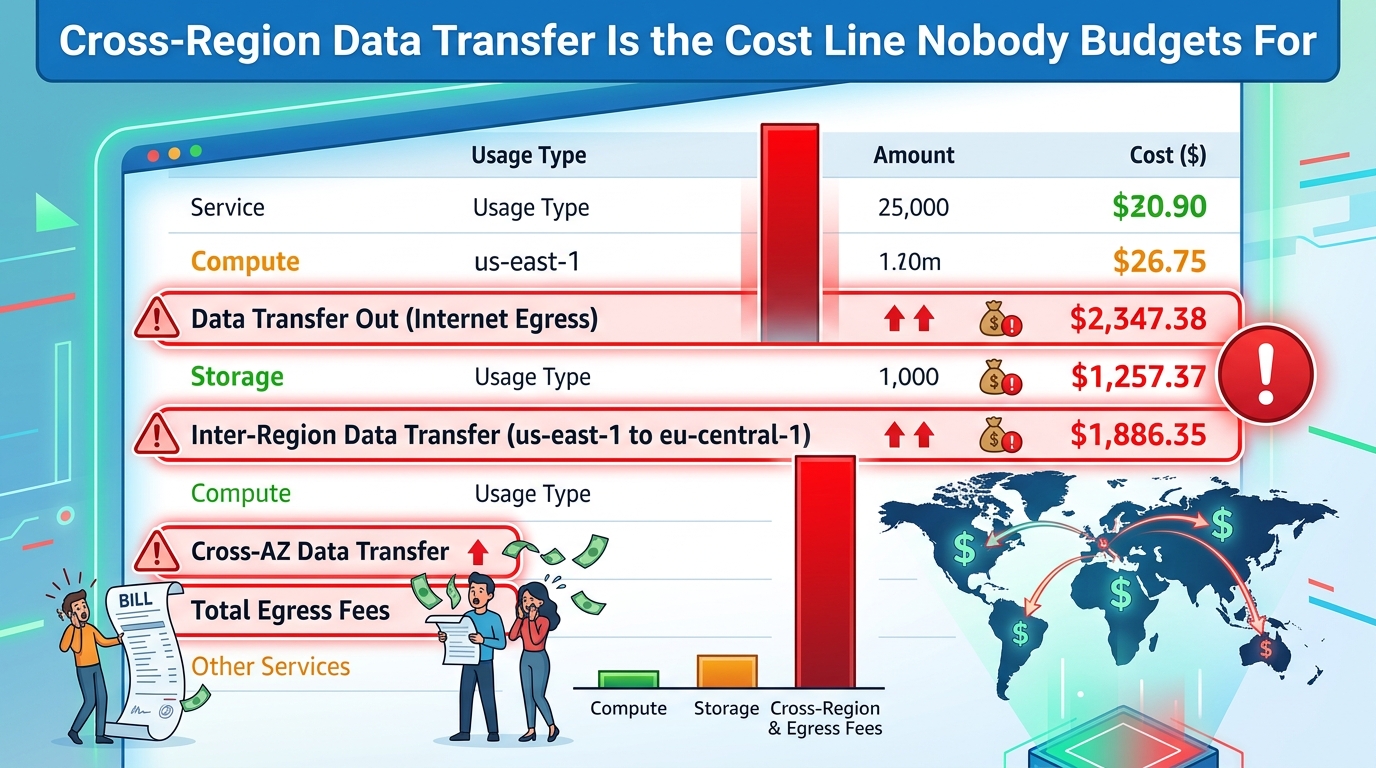

Key takeaway: Data transfer pricing is asymmetric, non-obvious, and charged per byte moved rather than per resource provisioned, which makes it the cost category most consistently omitted from architecture planning.
Why This Cost Gets Overlooked
Compute and storage costs map intuitively onto decisions engineers make deliberately — choosing an instance size, choosing a storage tier. Egress cost accumulates from decisions that were not framed as cost decisions at all: a service in one region calling a database in another, a multi-region replication strategy chosen for availability, a data pipeline moving results between cloud providers for tooling reasons.
None of these decisions had an obvious price tag attached at the point they were made, and none of them appear as a line item until the monthly bill arrives showing data transfer as a meaningful and sometimes dominant cost category that nobody specifically budgeted for.
Where It Concentrates
| Traffic pattern | Typical cost characteristic |
|---|---|
| Within the same availability zone | Usually free or minimal |
| Cross-zone, same region | Low, still non-zero |
| Cross-region, same provider | Meaningful, scales with volume |
| Cross-cloud provider | Highest, sometimes dramatically so |
| Egress to the public internet | Provider-dependent, often the highest tier |
Cross-cloud transfer is consistently the most expensive category and the one architects most often introduce unintentionally — a data pipeline that reads from one provider’s storage and writes to a different provider’s analytics platform, chosen because each tool was individually best-of-breed, without anyone calculating the transfer cost multiplied across the actual data volume moving between them continuously.
The Architectural Decisions That Actually Matter
Co-locating services that communicate frequently within the same region, and ideally the same availability zone, is the single highest-leverage change available, because it converts expensive cross-region calls into low-cost or free intra-zone ones without changing any application logic.
Caching aggressively at the edge or in a regional cache reduces the volume of data that needs to cross expensive boundaries repeatedly for the same content, converting many requests that would otherwise incur transfer cost into cache hits that do not.
Compressing data before transfer, particularly for large batch transfers between regions or providers, directly reduces the byte count that transfer pricing is based on, and is frequently a straightforward addition to an existing pipeline with a real, measurable cost impact.
Question multi-region replication strategies specifically for whether they are earning their transfer cost. Replication for genuine disaster recovery is a defensible cost; replication maintained out of habit long after the original justification is no longer relevant may not be.
Making the Cost Visible Before It Accumulates
Tag network traffic by service and destination where the cloud provider’s tooling supports it, so that when a transfer cost line item does appear, it can be attributed to a specific architectural decision rather than appearing as an undifferentiated total that nobody can trace back to its cause.
Include a transfer cost estimate as a standard part of architecture review for anything involving cross-region or cross-provider data movement, treating it with the same seriousness as compute sizing rather than as an afterthought discovered only once the bill arrives.
The Bottom Line
Co-locate frequently communicating services within the same region and zone wherever possible, cache aggressively to reduce repeated cross-boundary transfer, and compress large transfers. Estimate transfer cost explicitly during architecture review for any cross-region or cross-cloud design, because it is the cost category most reliably absent from planning and most reliably present on the eventual invoice.