Pod Affinity Rules Silently Stop Working When the Label Changes

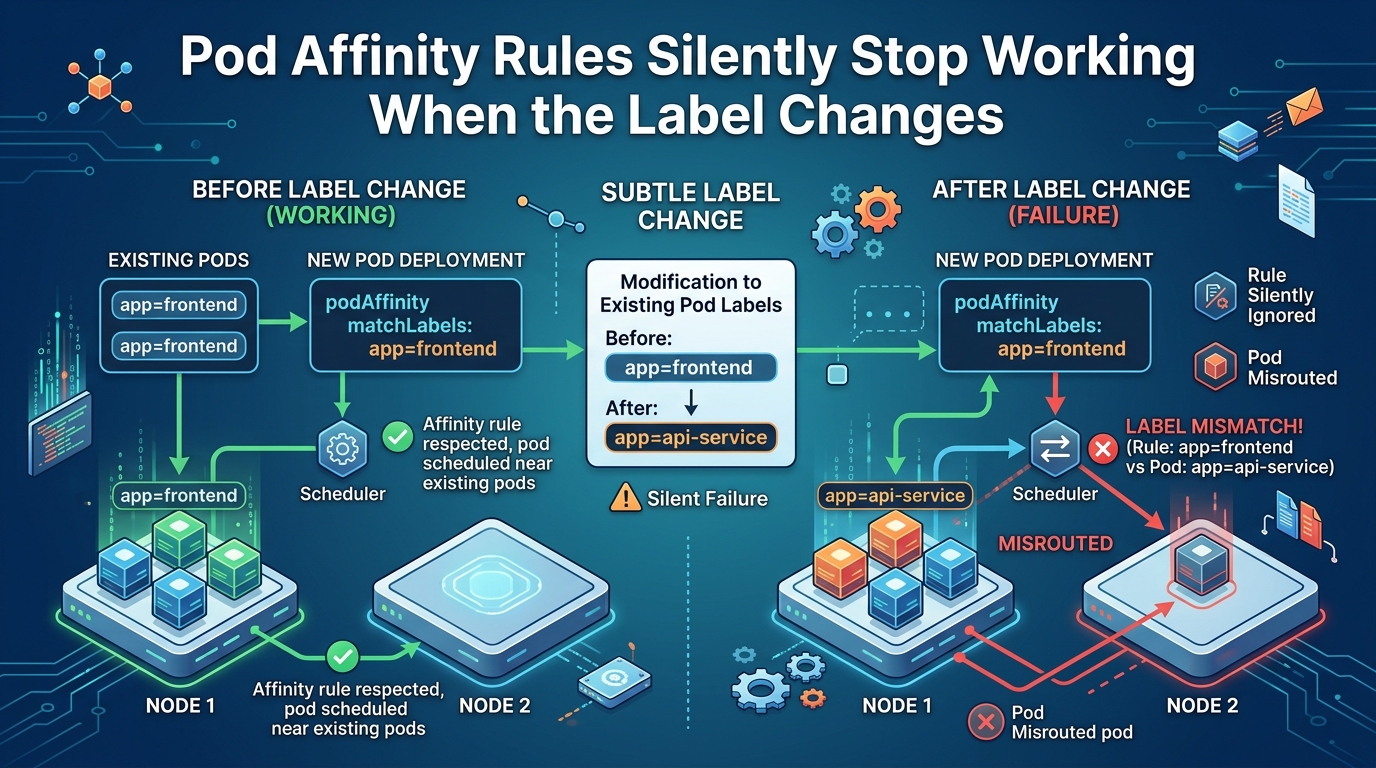
Key takeaway: Affinity and anti-affinity rules match on labels, and a label mismatch fails silently rather than loudly. The rule you believe is spreading pods across nodes may have stopped doing anything months ago.
The Failure Mode Nobody Notices
A team sets a pod anti-affinity rule so that replicas of a critical service never land on the same node, protecting against a single node failure taking down the whole service. It works correctly for a year.
Then a deployment template is refactored, a label gets renamed for consistency with a new naming convention, and the anti-affinity rule — which selects pods by that label — silently stops matching anything. The scheduler no longer sees any pods to avoid co-locating with, so it places replicas wherever capacity is available, including all three on one node.
Nothing errors. The rule is syntactically valid; it simply selects an empty set. The protection it was meant to provide disappeared the moment the label changed, and nothing in the system flags that disconnect.
Why This Is Especially Easy to Miss
Kubernetes does not validate that an affinity selector matches any existing pods at apply time — a selector matching nothing is entirely valid syntax, since new pods with matching labels might appear later. That flexibility is also why a broken selector produces no error signal at all.
| Failure | Visible symptom |
|---|---|
| Invalid YAML in the affinity block | Rejected at apply time |
| Selector referencing a label that never existed | No error, silently ineffective |
| Selector referencing a label that was renamed | No error, silently ineffective |
| Selector correct, but insufficient nodes to satisfy it | Pods stay pending — at least visible |
The insufficient-nodes case is actually the safer failure, because a requiredDuringScheduling constraint that cannot be satisfied leaves pods pending, which is loud and gets noticed quickly. A preferredDuringScheduling constraint that stops matching anything degrades silently to no constraint at all, with pods scheduling successfully in a configuration the team believes is protected and is not.
Verifying the Rule Actually Does Something
The only reliable check is querying which pods currently match the affinity selector and confirming the result is what you expect, rather than trusting that the YAML being present means the constraint is active.
Periodically inspect actual pod placement for services with anti-affinity rules and confirm replicas are genuinely distributed across nodes as intended. A quick audit comparing the node each replica landed on against the anti-affinity intent catches drift that no amount of reviewing the YAML in isolation would reveal.
Preferring Topology Spread Constraints Where Applicable
Topology spread constraints, a separate and more recent scheduling mechanism, express the same intent — distribute pods across a domain — more directly and with clearer failure semantics for many common cases. Where the goal is simply “spread replicas across nodes or zones evenly,” a topology spread constraint is often more legible and less prone to this specific silent-failure mode than an equivalent anti-affinity rule, because it operates on a topology key rather than requiring a label selector match against other pods.
Building In a Safety Net
Treat critical scheduling constraints as something to test, not just configure. A test that deploys the workload in a representative test cluster and asserts the resulting pod distribution matches the intended constraint catches both a broken affinity rule and a future refactor that accidentally breaks it again.
The Bottom Line
Do not trust that an affinity or anti-affinity rule is doing anything just because the YAML is present and valid — verify actual pod placement periodically against the intended distribution. Prefer topology spread constraints for straightforward spreading goals, and treat critical scheduling requirements as testable properties rather than configuration set once and assumed permanent.