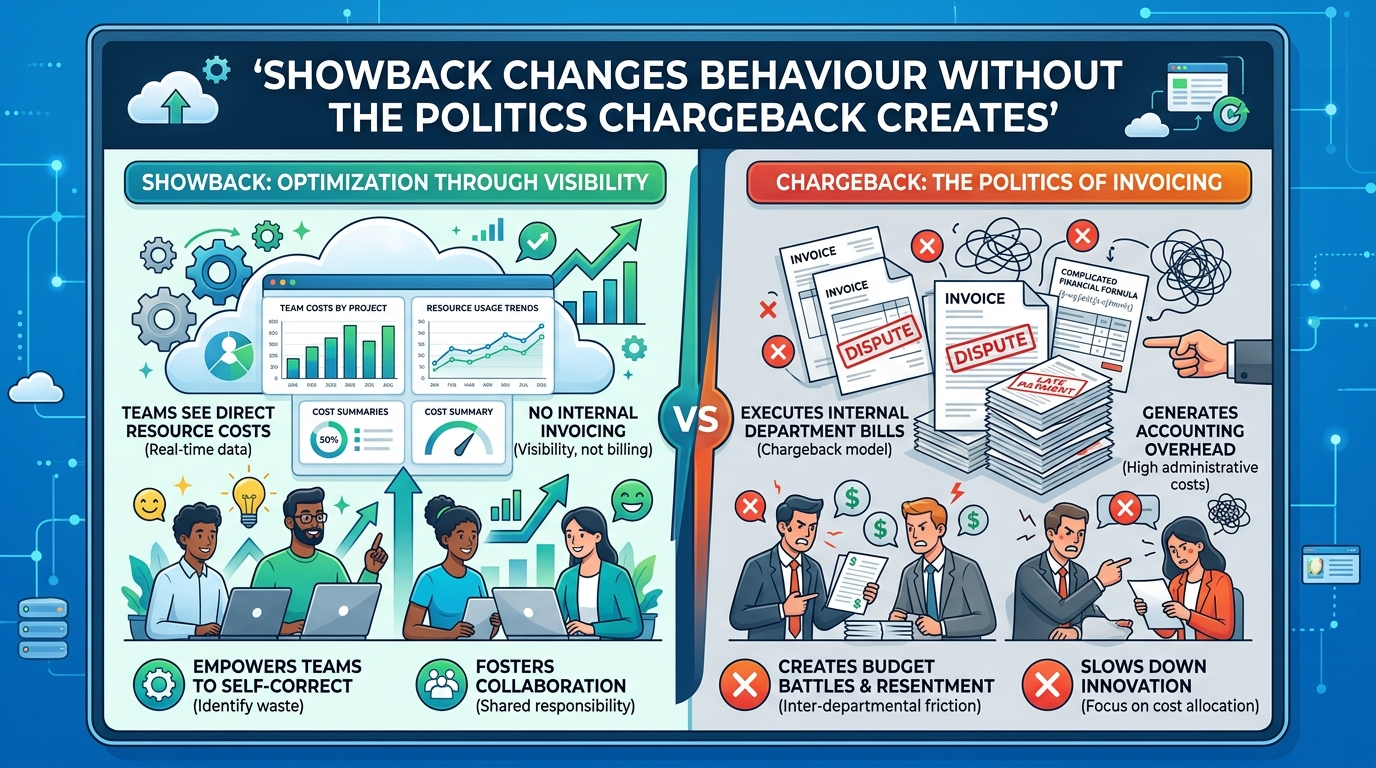

Key takeaway: Showback gives teams visibility into what they cost without moving money between budgets, which is usually enough to change behaviour and avoids the internal disputes that formal chargeback tends to generate.
The Difference in Mechanism
Chargeback actually debits a team’s budget for its measured cloud consumption, treating internal teams as though they were external customers of a cost centre. Showback reports the same consumption information without any budget transfer — the team sees what they cost and nothing moves.
The intuitive assumption is that chargeback, with real financial consequences, must drive more disciplined behaviour than showback, which has none. In practice this is frequently not true, and the reason is that chargeback introduces disputes about attribution accuracy that showback, having no financial stakes, never triggers.
Why Chargeback Generates Friction
The moment cost allocation determines an actual budget transfer, every team has a direct financial incentive to dispute how shared costs were attributed to them. Was the shared database cost split correctly? Should this team be charged for capacity that was over-provisioned by the platform team’s own default, not by anything the consuming team controlled? These questions become budget negotiations rather than engineering discussions.
| Property | Showback | Chargeback |
|---|---|---|
| Behaviour change from visibility | Yes | Yes |
| Real budget impact | No | Yes |
| Disputes over attribution accuracy | Rare | Common |
| Requires precise, defensible allocation | Helpful, not critical | Essential |
| Political complexity | Low | Often significant |
Chargeback essentially requires the cost allocation methodology to be defensible enough to survive a budget dispute, which is a much higher bar than showback needs to be useful. Shared infrastructure costs — a common database cluster, a shared network egress budget, a platform team’s own overhead — are inherently difficult to attribute perfectly to individual consuming teams, and that difficulty becomes a recurring point of conflict specifically when money is actually changing hands over it.
Why Showback Usually Achieves the Behaviour Change Anyway
Most cost-conscious behaviour change comes from a team simply seeing that their service costs more than they assumed, not from a budget penalty forcing the issue. An engineering team shown that their staging environment costs nearly as much as production, running twenty-four hours a day for no real reason, typically fixes it once they see the number — the visibility itself is the intervention, and no financial consequence was needed to motivate the fix.
This means showback captures most of the practical value chargeback promises, without needing to solve the harder problem of perfectly defensible cost attribution across shared infrastructure.
When Chargeback Is Actually Worth the Complexity
Chargeback earns its cost specifically where a team has genuine budget autonomy and cost is meant to be one input into their independent prioritisation decisions — a business unit deciding whether a feature is worth its infrastructure cost against its own P&L, for instance. In that context, real financial stakes are the point, not a side effect to be tolerated.
For most internal engineering teams without independent budget authority, this condition does not hold, and the political cost of chargeback is paid without the corresponding benefit that justifies it in the business unit case.
Making Showback Genuinely Effective
Showback only changes behaviour if it is visible and specific enough to act on — a quarterly PDF report is far weaker than a dashboard a team can check routinely, broken down by service rather than presented as one aggregate departmental number that nobody can trace back to a specific decision they could actually change.
The Bottom Line
Default to showback for internal engineering teams, since the visibility alone drives most of the available behaviour change without the attribution disputes chargeback invites. Reserve actual chargeback for situations with genuine budget autonomy where real financial stakes are the explicit point, and make whichever you choose visible and specific enough that a team can trace a number back to a decision they can act on.