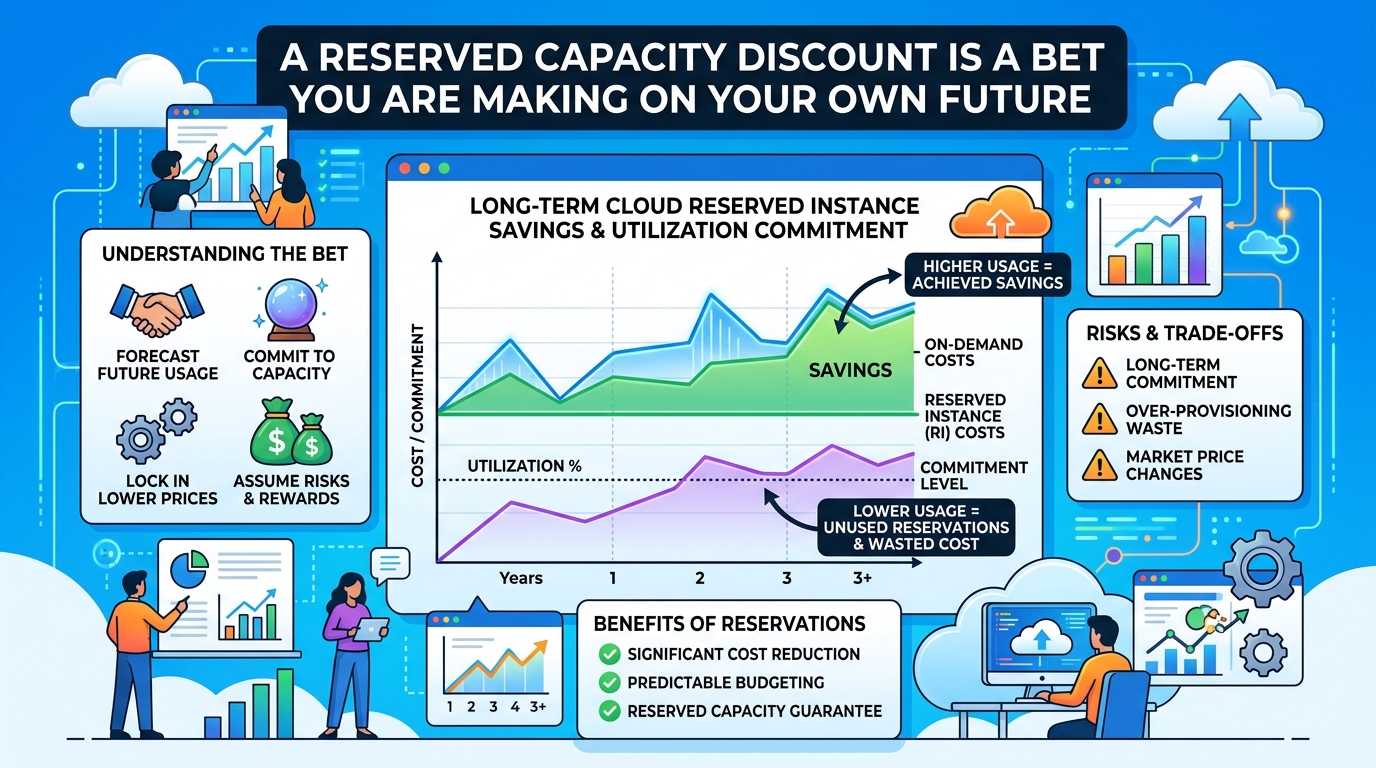

Key takeaway: Reserved capacity commitments are a forecast wearing a discount. Getting the forecast wrong converts a savings mechanism into a fixed cost you are paying regardless of whether you use the capacity.
What the Discount Actually Requires
Cloud providers offer meaningfully lower per-unit pricing in exchange for a committed spend over one or three years, applied against usage that matches the commitment’s terms. The discount is real and unconditional on one thing: that the committed level of usage actually continues to occur, because the commitment itself is a fixed obligation regardless of whether the capacity is used.
An organisation committing based on today’s usage and then shrinking that workload — through a successful cost optimisation effort, an architecture change, or simply reduced demand — is still paying for the full committed amount. The discount evaporates and the commitment becomes a straightforward fixed cost with no capacity benefit attached to justify it.
Where Forecasts Commonly Go Wrong
| Forecasting error | Consequence |
|---|---|
| Assumed steady-state growth that did not continue | Over-committed, paying for unused capacity |
| Committed before a planned architecture migration | Commitment sized for infrastructure being phased out |
| Ignored seasonal variation, committed to peak | Over-committed for most of the year |
| Committed organisation-wide without team-level visibility | Cannot identify which team’s usage the commitment tracks |
Committing immediately before a planned migration is a specific and avoidable trap — a team notices favourable reserved pricing and commits at exactly the moment a migration to different infrastructure, a different instance family, or a different cloud service was already planned, locking in a discount against capacity the organisation is about to stop needing.
Sizing Commitments Conservatively
The general principle that holds up well in practice is committing against the stable, well-understood baseline portion of usage — the workload that has run consistently for an extended period and shows no planned architectural change — while leaving variable, growing or uncertain usage on-demand or spot pricing where flexibility has real value.
This deliberately forgoes some available discount, because a smaller commitment captures the discount on genuinely predictable spend while avoiding the risk of over-committing on usage that might not persist. The forgone discount on the uncertain portion is the cost of avoiding a worse outcome if that usage changes.
Handling Existing Over-Commitment
Providers increasingly offer mechanisms to exchange, modify or resell unused committed capacity, and using these mechanisms actively rather than allowing an over-commitment to simply run out its term unused is worth the administrative effort — an unused commitment sitting idle for the remainder of its term is a sunk cost that active management can sometimes partially recover.
Review committed capacity utilisation on a schedule, not only when renewal approaches, so a shift away from full utilisation is caught and addressed months before the term ends rather than discovered only at the renewal decision point when options for that term are already limited.
The Bottom Line
Commit only against usage with a genuinely stable, well-understood history and no planned architectural change on the horizon, and leave uncertain or growing usage flexible even at the cost of a smaller captured discount. Review utilisation against commitments on an ongoing schedule rather than only at renewal, so a forecast that turns out wrong is caught while there is still time to act on it.