
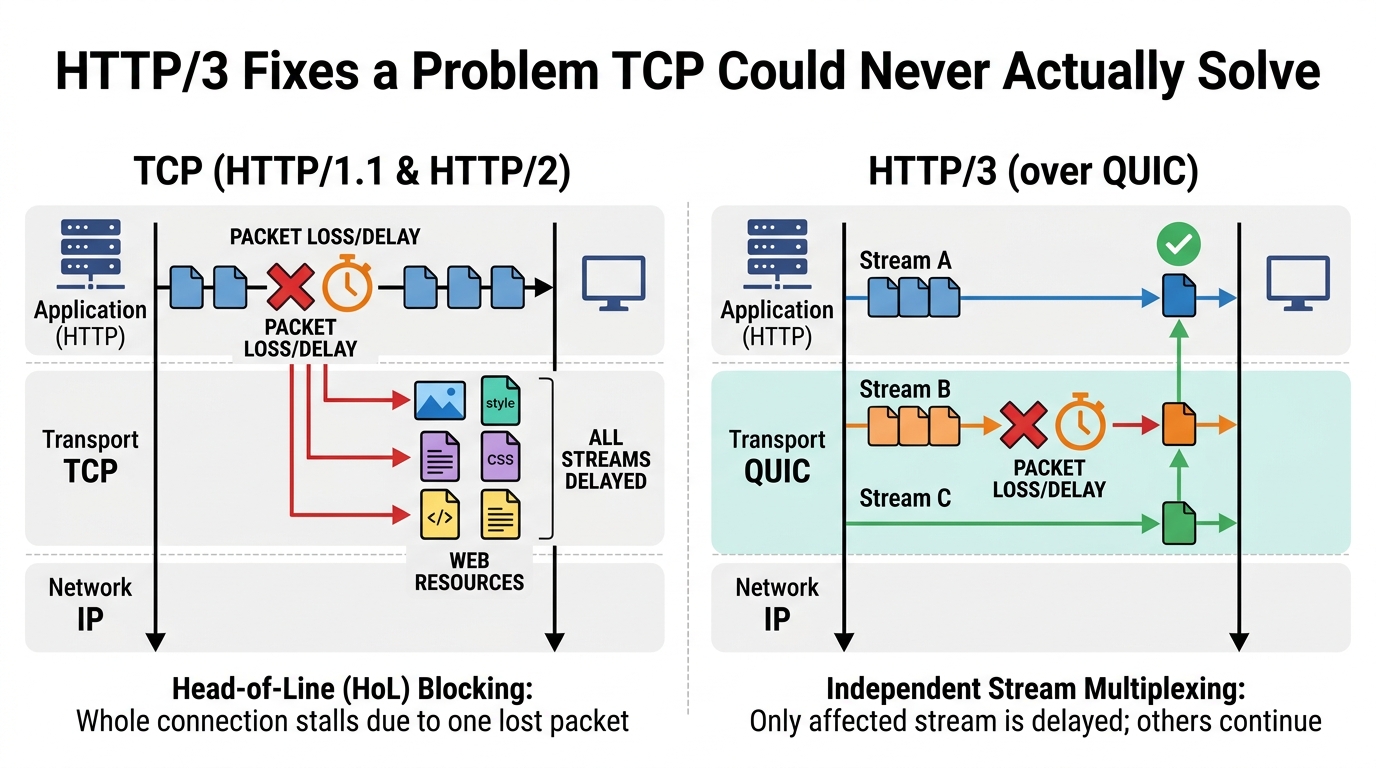

Key takeaway: HTTP/2 multiplexed requests over one TCP connection to reduce overhead, and inherited a flaw from TCP that no amount of application-layer cleverness could work around — QUIC fixes it by replacing the transport layer itself.
The Problem That Motivated This
HTTP/2 introduced multiplexing — many logical request streams sharing one TCP connection, avoiding the overhead of opening a separate connection per request. This was a genuine improvement and it inherited TCP’s fundamental guarantee: all bytes on a connection are delivered in order, without exception.
That guarantee, combined with multiplexing, produces head-of-line blocking at the transport layer. A single lost packet belonging to one stream stalls delivery of every other stream sharing that connection, because TCP will not deliver anything after the lost packet’s position until it is retransmitted and confirmed, regardless of whether the other streams’ data already arrived intact. On a lossy connection — mobile networks are the common case — this makes HTTP/2 multiplexing actively worse than separate connections would have been for exactly the loss conditions where reliability matters most.
Why This Could Not Be Fixed Within HTTP/2 Itself
The blocking happens below the application layer, inside TCP’s own ordering guarantee. No amount of clever request scheduling or stream prioritisation at the HTTP layer changes TCP’s behaviour underneath it — the fix required a different transport, not a different application protocol built on the same transport.
| Layer | HTTP/2 over TCP | HTTP/3 over QUIC |
|---|---|---|
| Transport | TCP | QUIC (over UDP) |
| Stream independence | No — one lost packet blocks all streams | Yes — each stream recovers independently |
| Connection migration (network change) | Breaks the connection | Survives, via connection ID |
| Encryption | Separate TLS layer | Integrated into the transport itself |
| Handshake round trips | More | Fewer, often combined with TLS |
What QUIC Actually Changes
QUIC implements multiplexed streams as a native transport-layer concept rather than layering them over TCP’s single ordered byte stream. Loss affecting one stream’s packets does not block delivery of other streams’ data that already arrived, because there is no longer one shared ordering guarantee spanning everything — each stream is independently ordered and independently affected by loss.
Connection migration is the second practical benefit, particularly relevant for mobile clients. A QUIC connection is identified by a connection ID rather than by the traditional IP-and-port tuple, so a client switching from Wi-Fi to cellular mid-connection can continue the same QUIC connection without a full reconnection, where the equivalent network change would have broken a TCP connection outright.
What Adoption Actually Requires
Enabling HTTP/3 at a CDN or load balancer edge is now largely a configuration change for the operator rather than an application rewrite, since most of the complexity is handled by the edge infrastructure and the client’s browser or HTTP library. The practical adoption decision is mostly about verifying client support and fallback behaviour rather than about application code changes.
Fallback to HTTP/2 for clients or intermediate networks that do not yet support QUIC over UDP needs to be verified rather than assumed, since some corporate and mobile networks historically restrict or deprioritise UDP traffic in ways that can degrade QUIC performance below what TCP-based HTTP/2 would have achieved on the same path — a real and non-obvious complication that argues for monitoring actual performance after enabling it rather than assuming the newer protocol is unconditionally better.
The Bottom Line
Enable HTTP/3 at the edge where your CDN or load balancer supports it, since it directly addresses a transport-layer limitation that HTTP/2 could never fix on its own regardless of application-layer effort. Verify fallback behaviour and monitor real-world performance afterward, because some networks handle the underlying UDP transport worse than they handle TCP, and that variance matters more than the protocol version in practice.


